
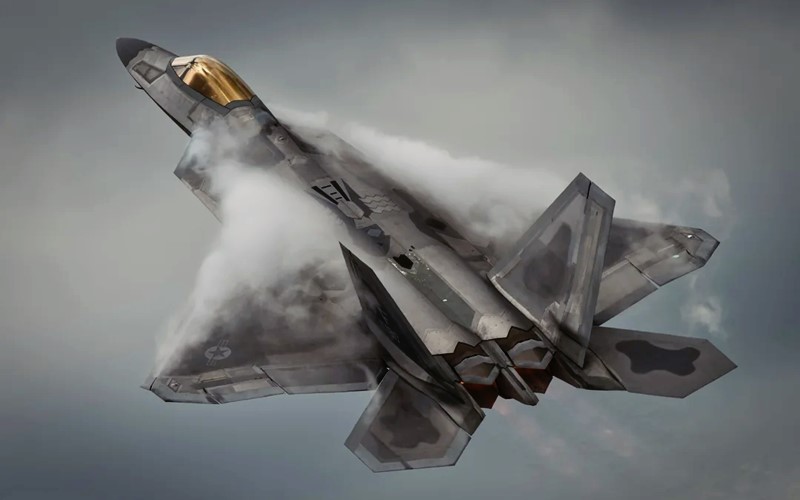
The U.S. Air Force, more than 20 years after receiving its first operational F-22 Raptor fighter jet, announced that the aircraft remains a key platform for maintaining air superiority…
Introduced into service in 2005, the fifth-generation fighter continues to play an important role in the U.S. Air Force’s deterrence missions.
The F-22 Raptor was developed to establish air superiority in heavily contested airspace through its stealth technology, high speed and maneuverability.
Assessments of the F-22 Raptor fleet’s flight hours and structural service life indicate that the aircraft has considerable technical service life remaining.
Under current U.S. Air Force planning, some F-22 aircraft are expected to remain in service until 2045, although a retirement schedule for the entire fleet has yet to be finalized.
The U.S. Air Force’s assessment indicates that the F-22A Block 30 aircraft bearing tail number 05-4089 has a maximum service life of 8,000 flight hours and is projected to be retired in 2045 based on its current utilization rate.
The F-22 Raptor is a fifth-generation fighter aircraft developed by U.S.-based Lockheed Martin and designed primarily for air superiority missions.
Powered by two Pratt & Whitney F119-PW-100 turbofan engines, the aircraft features low radar observability, Supercruise capability, and advanced radar and electronic warfare systems.
In addition to air-to-air missions, the F-22 can conduct air-to-ground strike missions using precision-guided munitions.
Each of the F-22’s two engines produces approximately 156 kN of thrust with afterburner, enabling the aircraft to reach speeds in the Mach 2 class.
The Raptor can also sustain supersonic flight at speeds above Mach 1.5 without using afterburners, thanks to its Supercruise capability.
With an operational ceiling of approximately 50,000 feet, the F-22 offers high maneuverability through its thrust-vectoring system and aerodynamic design, which also supports its low-observable characteristics.
The F-22 Raptor is equipped with the AN/APG-77 Active Electronically Scanned Array (AESA) radar developed by Northrop Grumman and the AN/ALR-94 electronic warfare system developed by BAE Systems.
These systems enable the detection and tracking of air and ground targets, as well as the identification of signals emitted by hostile radars and the localization of potential threats.
The Raptor can carry six AIM-120 AMRAAM and two AIM-9 Sidewinder air-to-air missiles in its internal weapons bays.
For air-to-ground missions, the aircraft can carry two GBU-32 JDAMs or eight GBU-39 Small Diameter Bombs (SDBs).
With its advanced stealth characteristics, sensor and electronic warfare systems, and multi-role weapons capability, the F-22 Raptor remains a key component of the U.S. Air Force’s air superiority capabilities and is expected to remain a central element of its operational force until next-generation fighters such as the F-47 enter service…