
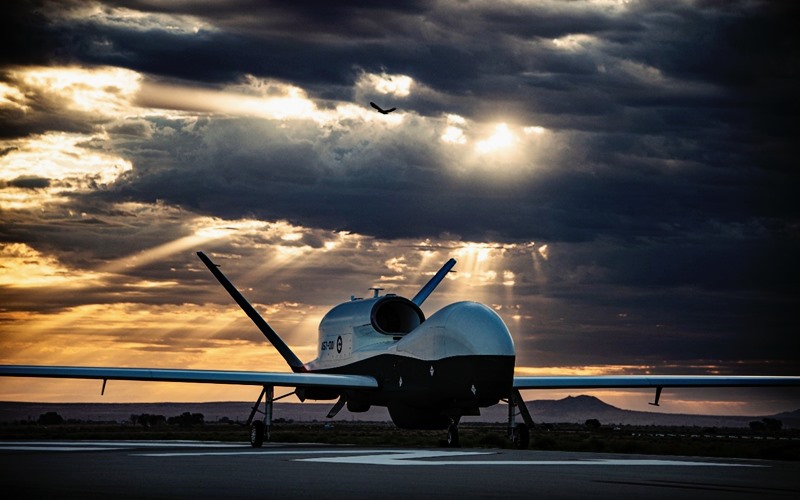
Australia announced that it has reached Initial Operational Capability (IOC) for its MQ-4C Triton UAV system…
The MQ-4C Triton is the Royal Australian Air Force’s long-range, high-altitude unmanned aerial vehicle (UAV) system.
The system is used for persistent intelligence, surveillance and reconnaissance (ISR), particularly for the long-endurance monitoring of extensive maritime areas.
Operating alongside P-8A Poseidon maritime patrol aircraft and MC-55A Peregrine electronic warfare/intelligence platforms, the system forms one of the key elements of the long-range air ISR architecture.
The MQ-4C Triton is a high-altitude, long-endurance (HALE) class unmanned aerial vehicle system developed by Northrop Grumman.
Capable of operating at an altitude of approximately 18,000 meters, the platform is designed for the long-endurance surveillance of wide areas, offering an endurance of more than 24 hours and a range of approximately 15,000 km.
Its propulsion system consists of a single Rolls-Royce AE 3007H turbofan engine, and the platform can reach a maximum speed of approximately 575 km/h.
The Triton’s core sensor package includes the AN/ZPY-3 Multi-Function Active Sensor (MFAS) AESA radar, electro-optical/infrared (EO/IR) sensors, and electronic support measures (ESM) systems…